Results
Fourteen participants scored above 80% on all runs, the remaining participant scored above 70% on all runs and twelve of the participants scored above 90% on all runs. The results of the study demonstrate that it is possible to discriminate several mental workload levels using EEG. By using the traditional EEG bands, average workload classiffication accuracies reached 81.1% for the 0- vs. 2-back task and 63.9% for 0- vs. 1- vs. 2-back task. After HF-suppression, classification accuracies of 73.6% and 60.6% can be achieved using the same frequency band.
Results suggest that the cognitive workload tasks generated individual differences in brain activity, which probably need subject-specific models and therefore the development of such. Furthermore, muscle tension-related EMG may contribute to the classification of cognitive workload.
If pratical cognitive workload discrimination is effective without the isolation of EEG from EMG, then there might be no need to do so. Note however, that in that case precautionary measures have to be taken to ensure that the EMG does not dominate the EEG, as only the latter is the intrinsic biomarker for cognitive workload.
Concrete Results
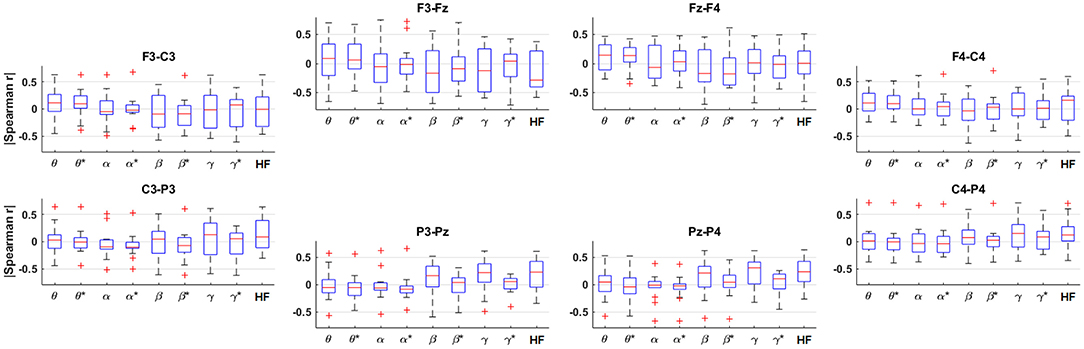
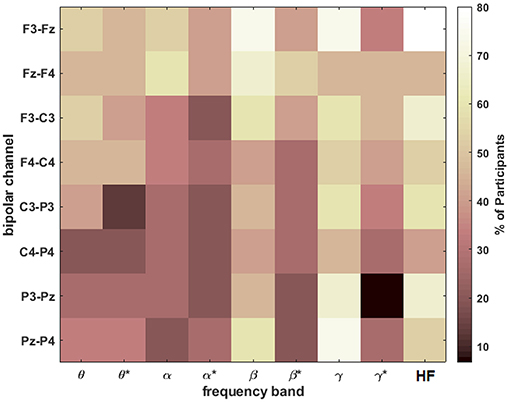
Figure 1 indicates that the most consistent features acrossparticipants are frontal β and γ and parietal γ prior to HF-suppression, although after HF-suppression only frontal β and γ are the most consistent features(although less consistent prior suppression).
Examining the univariate features, shown in Figure 2, the parietal activity above the α band is generally positively correlated with workload level. Besides that, high variabliity exists across participants, which is consistent with Brouwer et al.[1]. Classical fronto-parietal &alhpa;/θ activations[2][3][1:1] were not consistently observed. This may be due to the interactive, immersive VR design. A study has shown, that VR generated more β/γ activity compared to the real-world in hand illusion experiments[4] and another study showed that EEG during an VR stepping game had statistically-significant hemispherical differences in the α, β, γ bands[5].
Spatial vs Spectral Features
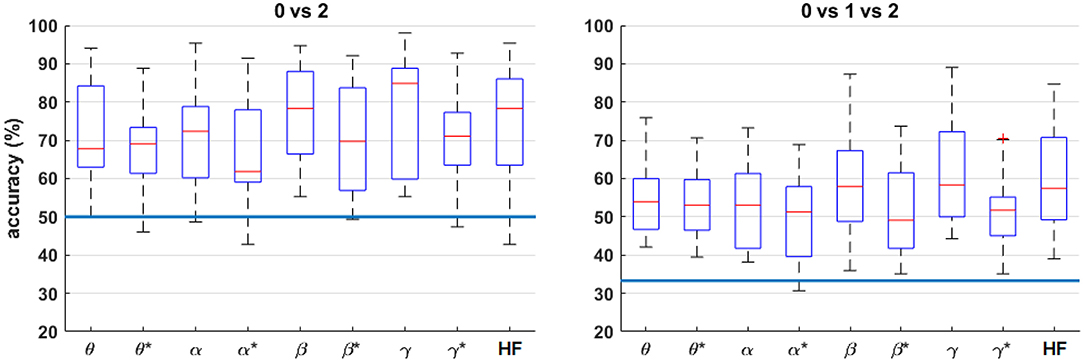
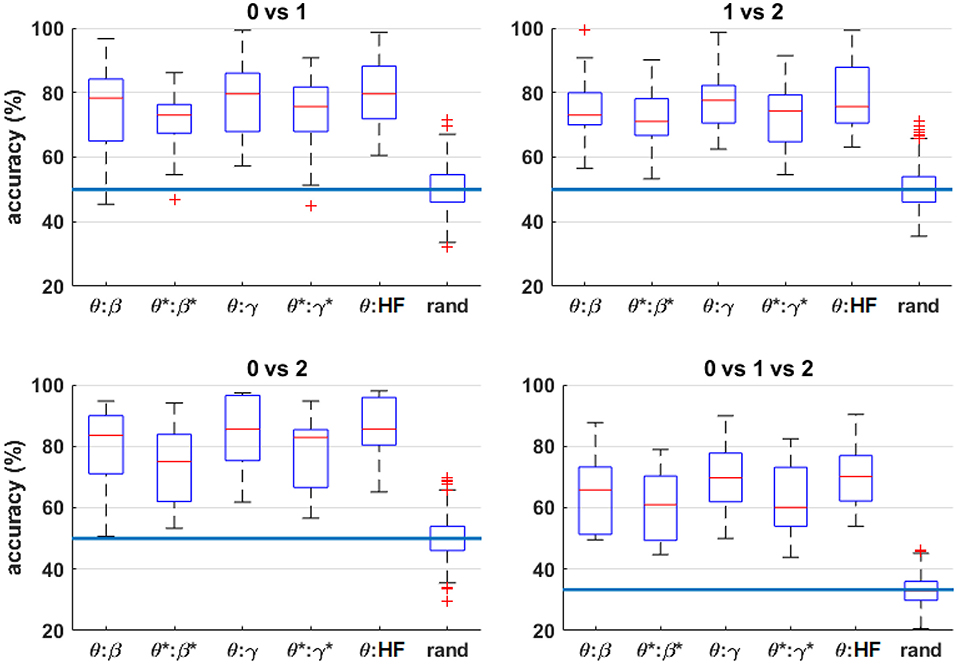
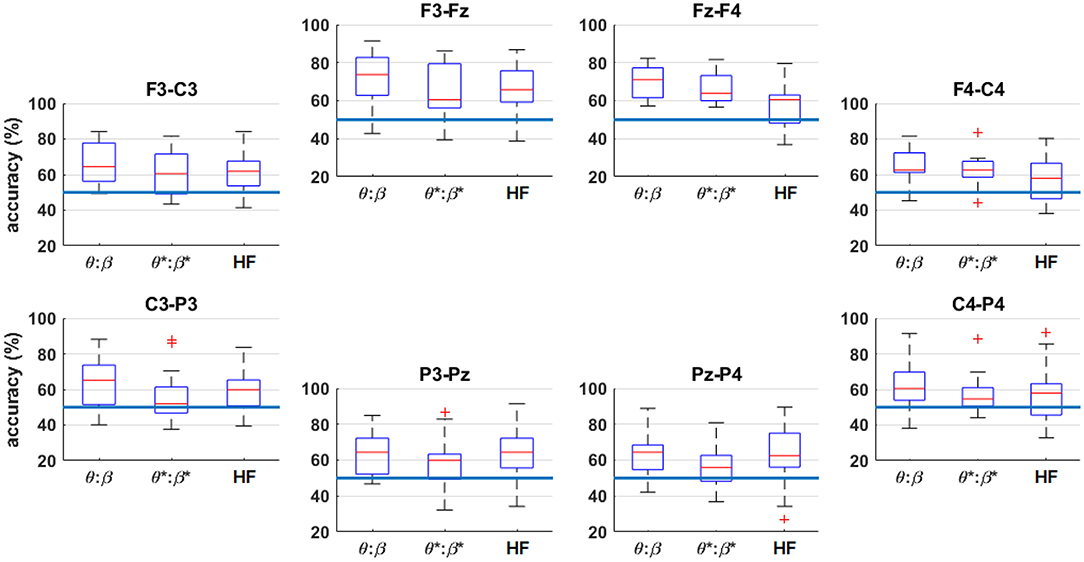
Looking at Figure 5, the frontal channels are likelier to result in higher classification accuracies. When evaluating, whether spatial(Figure 5) and spectral(Figure 3) in isolation perform better or not, it can be noted that in general there are no drastic differences in the performances across bands or channels. However, looking at the combined-band in Figure 4, it can be seen that information from multiplee frequencies and channels is crucial for maximizing performance.
Problems with Linear Regression
While linear regression is used to remove the correlated activity of a high-frequency band from the low-frequency EMG, this approach may produce a reasonable approximation. However, this approach is still naive and has issues, mainly due to its assumption that there is a linear relationship between the dynamics of EMG contamination across frequency bands[6]. Moreover, assuming the high-frequency EMG is highly-correlated with the task(as mentioned in the Methodology Section), removing or suppression this will ultimately also supress the desired genuine EEG[7]. Overall these two effects may cancel and result in a reasonable estimate of the lower-frequency EEG activity.
Brouwer, A.-M., Hogervorst, M. A., van Erp, J. B. F., Heffelaar, T., Zimmerman, P. H., and Oostenveld, R. (2012). Estimating workload using EEG spectral power and ERPs in the n-back task. J. Neural Eng. 9:045008. doi: 10.1088/1741-2560/9/4/045008 ↩︎ ↩︎
Sauseng, P., Klimesch, W., Schabus, M., and Doppelmayr, M. (2005). Fronto-parietal EEG coherence in theta and upper alpha reflect central executive functions of working memory. Int. J. Psychophysiol. 57, 97–103. doi: 10.1016/j.ijpsycho.2005.03.018 ↩︎
Sauseng, P., Griesmayr, B., Freunberger, R., and Klimesch, W. (2010). Control mechanisms in working memory: a possible function of EEG theta oscillations. Neurosci. Biobehav. Rev. 34, 1015–1022. doi: 10.1016/j.neubiorev.2009.12.006 ↩︎
Škola, F., and Liarokapis, F. (2016). Examining the effect of body ownership in immersive virtual and augmented reality environments. Vis. Comput. 32, 761–770. doi: 10.1007/s00371-016-1246-8 ↩︎
Oliveira, S. M. S., Medeiros, C. S. P., Pacheco, T. B. F., Bessa, N. P. O. S., Silva, F. G. M., Tavares, N. S. A., et al. (2018). Electroencephalographic changes using virtual reality program: technical note. Neurol. Res. 40, 160–165. doi: 10.1080/01616412.2017.1420584 ↩︎
Kim, B., Kim, L., Kim, Y.-H., and Yoo, S. K. (2017). Cross-association analysis of EEG and EMG signals according to movement intention state. Cogn. Syst. Res. 44, 1–9. doi: 10.1016/j.cogsys.2017.02.001 ↩︎
Mühl, C., Jeunet, C., and Lotte, F. (2014). EEG-based workload estimation across affective contexts. Front. Neurosci. 8:114. doi: 10.3389/fnins.2014.00114 ↩︎