Combining Mental Training and Physical Training With Goal-Oriented Protocols in Stroke Rehabilitation
A Feasibility Case Study
Combining Mental Training and Physical Training With Goal-Oriented Protocols in Stroke Rehabilitation
Stroke is a leading cause of permanent disability in adults[1], with rehabilitation being crucial for early motor recovery. Despite its importance, conventional therapy for stroke rehabilitation can be both time-consuming and expensive[2]. The field of stroke rehabilitation using robotic devices has seen significant advancements in recent years, but many current methods lack the integration of both physical and mental training. In this study by Zhang et al.[3], a new portable platform for stroke rehabilitation is proposed which addresses this issue. The platform consists of an EEG-based BCI system for mental training and a force sensor embedded orthosis with a functional electrical stimulation (FES) unit for physical training. This so-called BF control mechanism was designed to combine both mental and physical efforts to trigger the assistance provided by the orthosis. A progressive functional training protocol with increasing levels of difficulty was also developed to complement the hardware design. The effectiveness of the platform was assessed through motor improvements measured by the Wolf Motor Function Test (WMFT). This innovative approach to stroke rehabilitation has the potential to greatly enhance the recovery process for those affected by stroke.
General Setup
Hardware
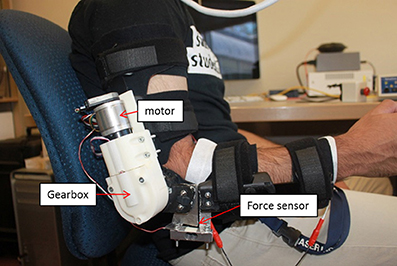
The elbow orthosis (see Figure 1) used in this study is a modified arm robot prototype developed in the author's lab. It's made from a commercially available brace and has one degree of freedom for elbow movement. The orthosis is actuated by a brushless motor and measured by a potentiometer and encoder. It's encased in a ABS plastic casing and has a micro force sensor to measure interaction forces. The orthosis has a total torque of 9.4 Nm, weighs 930 g, and has a range of motion between 30-120 degrees. Advantages of the orthosis include being lightweight, portable, easy to put on/take off, and not interfering with the user's natural arm position.
The study utilized a functional electric stimulation (FES) device to support wrist and hand extension. The device produced symmetrical pulses with a frequency of 35 Hz and a peak duration of 150 µs. The participant wore two electrodes on the forearm to facilitate wrist and finger flexion. The stimulation amplitude was gradually increased until the impaired hand was fully extended comfortably.
The EEG data was collected from a participant using a 32-channel system. The EEG data was then processed in two steps: (1) collection of EEG data to build a BCI model of the participant, and (2) use of the model to classify the participant's intentions in real-time.
Participant
| Criteria | Value |
|---|---|
| Age | 35-85 |
| Post-stroke duration | ≥6 months |
| MoCA | ≥25 |
| Shoulder active ROM | 10–15° in all directions |
| Elbow passive extension and flexion ROM | 0–130° |
| Wrist passive extension ROM | 0–15° |
| Passive full extension for fingers | available |
Based on the inclusion criteria depicted in Table 1, a 37-year-old male with aphasia who was 11 years post-stroke was selected as participant.
For evaluation, three baseline assessments were conducted with a two-week interval between each. The participant underwent additional testing every two weeks during the training session. The main evaluation was the assessment of the participant's motor ability using the Wolf Motor Function Test. Additional secondary evaluations included Fugl Meyer Assessment (FMA) and the rate of device activation during each training day. The participant was required to complete the WMFT and FMA every other two weeks with a "blind" test administrator who was not aware of or involved in the study protocol.
Training Phase
Mental Training
The EEG data was recorded and filtered during a "Stimulus Presentation" mode, where the participant was asked to relax and perform kinesthetic motor imagery of elbow movement. The collected EEG data was analyzed offline using BCILAB toolbox, with a focus on the 6-35 Hz frequency band which covers mu and beta rhythms related to motor imagery. Three feature extraction algorithms and three classifiers were tested for the best combination using a 10x10 cross-validation. The highest accuracy model, consisting of Common Spatial Pattern (CSP) and Linear Dsicriminant Analysis (LDA), was used for online classification, where the EEG signal was filtered and processed to send commands to an orthosis control module. The activity threshold was set to minimize false positives and was determined through a pre-training process.
Physical Training
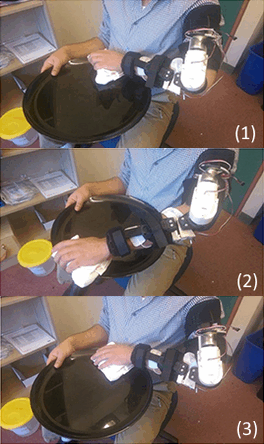
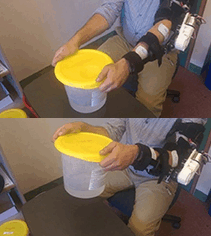
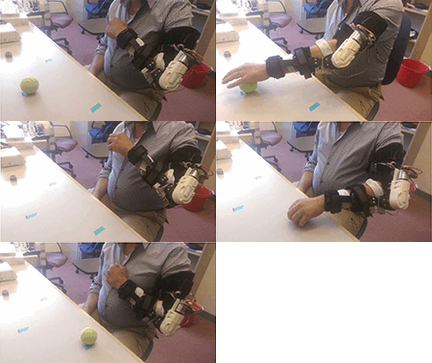
The warm-up training for the stroke rehabilitation platform consisted of three basic sessions to familiarize the participant with the orthosis system and BCI control methods. Session 1 involved passive movements of the elbow and hand with the orthosis and FES, lasting 30 minutes for each movement and repeating 25 times. Session 2 required the participant to trigger the orthosis using kinesthetic motor imagery through EEG, lasting half an hour for each movement with a minimum of 10 repetitions. Session 3 involved combining imaging and physical movement using BF control for the elbow and FES for the hand, designed to familiarize the participant with the control components of the training protocols
The actual training protocol involves practicing 4 goal-oriented tasks over 12 days, with each task having 3 levels of difficulty.
Level 1 involves only elbow movement through simple flexion/extension, performed while wearing an orthosis that can be triggered by brain-computer interface (BCI) control. The participant imagines washing a plate and extends their elbow (see Figure 2), and the orthosis assists if the BCI check is successful. If not, the orthosis extends the elbow passively.
Level 2 involves bilateral control and coordination, with the participant lifting a bucket by flexing both elbows while wearing the orthosis (see Figure 3). The same BCI control method applies as in level 1.
Level 3 involves reach, grasp, place and release an object (see Figure 4), with the addition of functional electrical stimulation (FES) to assist hand control. The participant extends their elbow to reach and grab an object, and the FES unit opens their hand. The participant then flexes their elbow to pick up the object, extends their elbow to place it down, and flexes their elbow to return to the initial position. The same BCI control method applies as in levels 1 and 2, and a trial is considered successful if the participant triggers the BCI system and moves in the correct direction. If not, the orthosis performs the movement passively to maintain a minimum number of repetitions.
Results
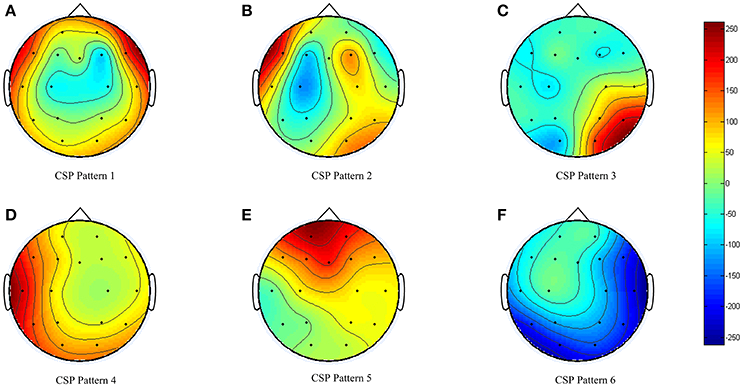
The study focused on the feasibility of a BCI (Brain-Computer Interface) training platform for a participant who suffered a stroke affecting their left hemisphere. The participant was asked to imagine movements of their right upper limb during stimulus presentation sessions. The BCI system was able to accurately capture the participant's ERD (Event-related Desynchronization) for motor imagery (see Figure 5B), with an offline analysis accuracy of 80.1% (reasonable considering the participant had no prior BCI experience). The participant showed improvement in upper extremity motor function as measured by the WMFT (Wolf Motor Function Test) tasks, with the most improvement seen in the Hand-to-Box and Weight-to-Box tasks on the affected side. However, there was no improvement in fine motor tasks. The BSI (Brain Symmetry Index) calculations showed a positive correlation between motor imagery BSI and averaged WMFT score. The results suggest that the participant improved control, coordination, and strength in some of the shoulder, elbow, and forearm joint/muscles with repetitive training over 6 weeks.
However, this was a case study, and the results cannot be generalized. The study's limitations include a small population and difficulty in independently setting up the training platform.
GBD 2019 Diseases and Injuries Collaborators. (2020) Global burden of 369 diseases and injuries in 204 countries and territories, 1990–2019: a systematic analysis for the Global Burden of Disease Study 2019. The Lancet vol. 396, issue 10258: 1204–1222. doi ↩︎
American Heart Association. (2016) Executive Summary: Heart Disease and Stroke Statistics—2016 Update. Circulation vol. 133, issue 4: 447–454. doi ↩︎
Xin Zhang, Ahmed M. Elnady, Bubblepreet K. Randhawa, Lara A. Boyd, and Carlo Menon. (2018) Combining mental training and physical training with goal-oriented protocols in stroke rehabilitation: A feasibility case study. Frontiers in Human Neuroscience 12: 125. doi ↩︎