Enhancement of SSVEPs Classification in BCI-Based Wearable Instrumentation Through Machine Learning Techniques
Enhancement of SSVEPs Classification in BCI-Based Wearable Instrumentation Through Machine Learning Techniques[1]
This Wiki article is based on the study "Enhancement of SSVEPs Classification in BCI-Based Wearable Instrumentation Through Machine Learning Techniques," produced by A. Apicella et al. in IEEE Sensors Journal, vol. 22, no. 9, pp. 9087-9094, 1 May1, 2022
Overview
Machine learning classifiers and convolutional neural networks are used in this work, aiming to provide better performance of highly wearable instrumentation for Brain-Computer Interfaces. Four different Head-Mounted Displays are employed in the experiments with two strategies as well as state-of-the-art techniques. The Study compares them to get a better solution. The results show that the adopted strategies significantly outperform the state-of-the-art. On the other hand, the specification and characterization of AR HMDs are also crucial for classification accuracy. Furthermore, Leave-One-Out Cross Validation is adopted and it leads to an increase in the inter-individual 1-
Abbreviation
Some abbreviation that appears in this article are listed below(with the first character from A to Z)
The highlighted abbreviation has a hyperlink.
-
AR - Augmented Reality
-
ANN - Artificial Neural Network
-
BCI - Brain-Computer Interface
-
CCA - Canonical Correlation Analysis
-
EEG - Electroencephalogram
-
FFT - Fast Fourier Transform
-
FOV - Field of view
-
FR - Feature Reduction
-
HMD - Head-Mounted Display
-
k-NN - k-nearest neighbors
-
ML - Machine Learning
-
SCU - SSVEPs Convolutional Unit
-
SSVEPs - Steady-State Visually Evoked Potentials
-
SVM - Support Vector Machine
-
1-
sigma reproducibility
The abbreviation in italic in this Wiki article can all be found in this list.
BCI Features
Compared with traditional SSVEP-based experimental setups, the wearable instruments are based on the single-channel acquisitions of EEG samples. In this scenario, AR HMDs are used to render the flickering stimuli and guarantee more immersivity and engagement in the fruition of BCI applications. [2][3]
The specifications of the HMD affect the performance in two ways. The first is the FOV of HMDs, which is normally limited to some tens of degrees. The second is the non-predictability of the frame rate. In other words, the rendered stimuli may have a shifted frequency value. So it reduces the classification accuracy of the SSVEP.[4]
Experiment Proposal
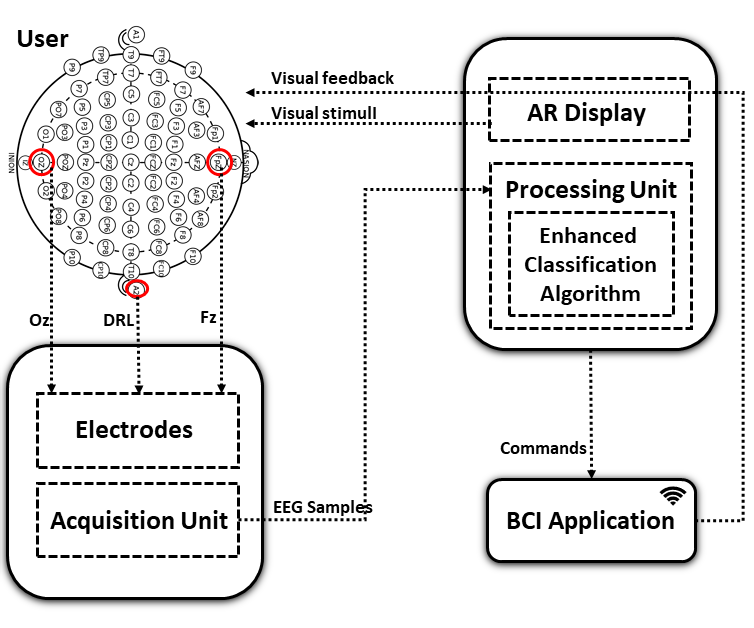
Fig.1 summarizes the major blocks of the system architecture. In particular, an AR Display renders the flickering stimuli in the range of 8-15 Hz for the SSVEPs elicitation. Only three electrodes are used: a pair of active and dry electrodes are placed in Oz and Fz positions while a passive electrode is placed on the earlobe and acts as a reference.[1:1]. This is to reduce the common mode interference.
The brain signal is digitized by a portable Acquisition Unit, which sends the EEG samples to a portable Processing Unit. This signal is processed with the Enhanced Classification Algorithm, and the detected command is sent in real-time to the BCI Application, which also provides visual feedback to the User as the output of the desired selection. In this work, two strategies are adopted in the Enhanced Classification Algorithm block, namely Feature Reduction (FR) and Deep SSVEP Convolutional Unit (SCU).
Feature Reduction
-The EEG Samples are processed both in frequency and time domains, to obtain a reduced number of significant features.
-Given a brain signal composed of fsN EEG samples and n classes, only 2n features are extracted and normalized.
-Finally, the Classification is carried out with three ML classifiers: Support Vector Machine (SVM), k-Nearest Neighbor (k-NN), and Artificial Neural Network (ANN). These three are chosen for best performance based on acceptable computational effort. [5]
Deep SSVEP Convolutional Unit
-This strategy adopts all the EEG samples acquired in the time window.
-It consists of one or more defined SCU blocks and is connected with Dense blocks.
-The optimal hyperparameters are found through a grid-search approach (see table 1).
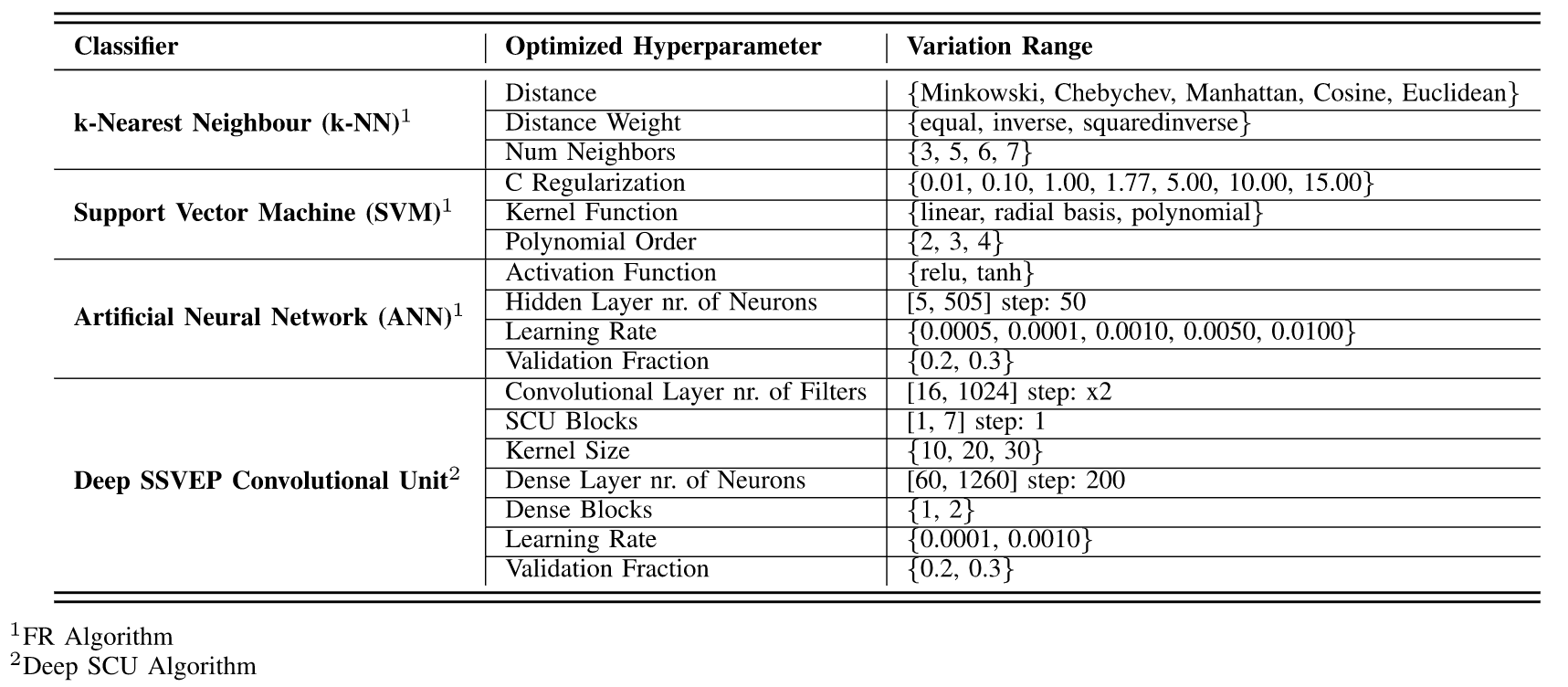
Table 1 : Classifiers, optimized hyperparameters, and variation ranges[1:2] (just to give a intuitive impression, no need to look deep into it)
Characterization
Four experiments were conducted, in which a different AR HMD was adopted.
The AR devices used are listed below:
- Epson Moverio BT-200
- Epson Moverio BT-350
- Microsoft Hololens 1
- Oculus Rift S
Thus four distinct data sets are processed for further tests of SSVEPs classification algorithms.
The software employed is:
- Epson Moverio BT-200/350: in Android Studio
- Microsoft Hololens and Oculus Rift S: in Unity 3D
The frequencies chosen for each data set are:
- Data set #1(BT-200): 10.00, 12.00 Hz
- Data set #2(BT-350): 8.00, 10.00, 12.00, 15.00 Hz
- Data set #3(Hololens): 8.57, 10.00, 12.00, 15.00 Hz
- Data set #4(Rift S): 8.00, 10.00, 11.43, 13.33 Hz
For each trial, a volunteer was asked to focus on the selected stimulus for 10s.
Results
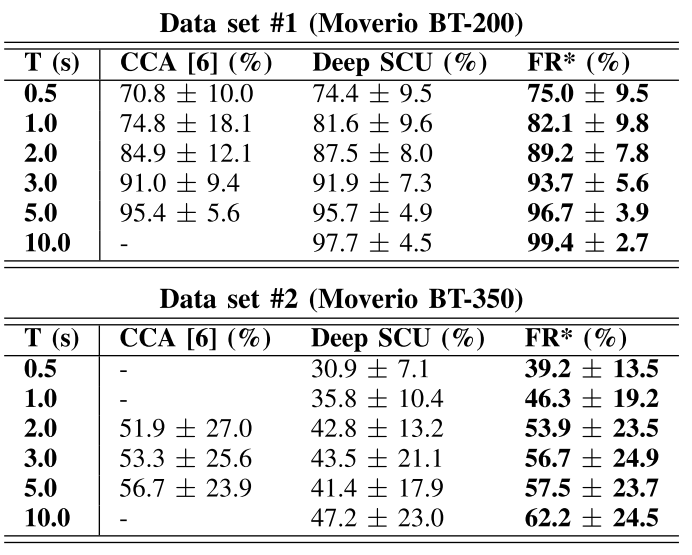
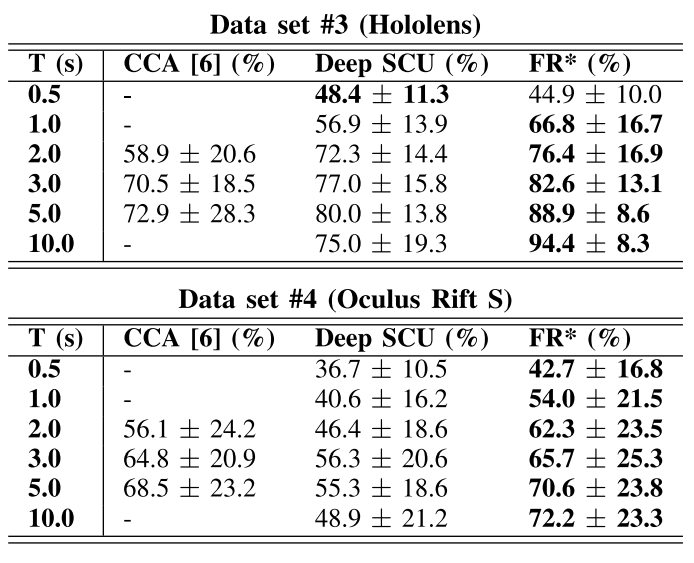
Table 2 : Classification accuracy and corresponding 1-
(*Only the best result is reported for brevity)
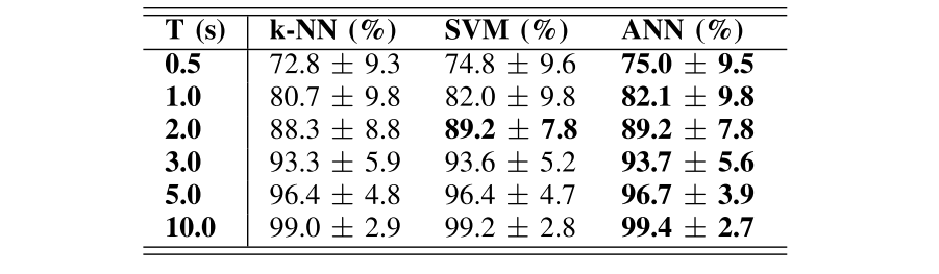
Table 3 : FR Algorithm results obtained for data set #1(BT-200) for dach considered model[1:4]
The performance was assessed both on the classification accuracy and the related time response. The time response is the epoch (signal duration T) extracted for each trial. The classification accuracy is the percentage of the data set that is correctly classified.
Table 2 shows that as the size of epochs increases, the classification accuracy increases. On the other hand, the enhancement reached by the FR algorithm is significant in each data set. Some results are emphasized in bold, which indicates that the adoption of ML techniques improves classification accuracy. The main contribution to this improvement is based on the peak detection block. The peak detection block mitigates the uncertainty caused by unpredictable fps variation of AR devices. For future studies, an adaptive strategy to find the FFT peak position represents the best solution for accuracy improvement. The deep SCU algorithm also outperforms CCA on data sets #1 and #3.
To compare the performance of each AR HMD, it shows that Epson Moverio BT-200 (data set #1) provides significantly best performance ( almost 90% at 2 s), while BT-350 has only a percentage accuracy of 50%. It is because only two flickering stimuli were rendered simultaneously on the display BT-200, but in BT-350 there were 4 instead. The larger FOV also seems to be an influential factor. This is to avoid interferences when the user stares at the desired icon.
Table 3 shows the performance results with each ML technology for data set #1. The best performance is obtained by ANN classifier. However, there are only slight differences among them, and even a more simple classifier (k-NN) provides an adequate accuracy level.
Conclusion
- The experimental results show that the proposed ML-based processing strategies improve the system performance of the highly wearable, single-channel instrumentatino for BCI with respect to the state-of-the-art technology. The performance is assessed in terms of classification accuracy and time response.
- In particular, the combined use of both time-domain and frequency-domain features (in FR technology) improves the performance by means of mitigating the uncertainty that introduced from visual stimuli.
- Even a more simple ML classifier like k-NN can outperform the traditional strategy CCA. This represents a great advantage in highly wearable devices. In other words, acceptable performance can be achived through a low-number-channel display and relatively small computational complexity.
- In addition, using ML increase the inter-individual 1-
sigma reproducibility, which leads to more "ready-to-use" systems. - The work also shows a significant difference in the classification accuracy between two-stimuli and four stimuli setups. The decline in performance is caused by reduced FOV of the divices and interference between gazed and non-gazed flickering stimuli.
References
A. Apicella et al., "Enhancement of SSVEPs Classification in BCI-Based Wearable Instrumentation Through Machine Learning Techniques," in IEEE Sensors Journal, vol. 22, no. 9, pp. 9087-9094, 1 May1, 2022, doi: 10.1109/JSEN.2022.3161743. ↩︎ ↩︎ ↩︎ ↩︎ ↩︎
Tedesco, A., Dallet, D., Arpaia, P. (2021). Augmented Reality (AR) and Brain-Computer Interface (BCI): Two Enabling Technologies for Empowering the Fruition of Sensor Data in the 4.0 Era. In: Di Francia, G., Di Natale, C. (eds) Sensors and Microsystems. AISEM 2020. Lecture Notes in Electrical Engineering, vol 753. Springer, Cham. ↩︎
Pasquale Arpaia, Egidio De Benedetto, Lucio De Paolis, Giovanni D'Errico, Nicola Donato, Luigi Duraccio,
Highly wearable SSVEP-based BCI: Performance comparison of augmented reality solutions for the flickering stimuli rendering, Measurement: Sensors, Volume 18, 2021. ↩︎Pasquale Arpaia, Egidio De Benedetto, Luigi Duraccio, Design, implementation, and metrological characterization of a wearable, integrated AR-BCI hands-free system for health 4.0 monitoring, Measurement, Volume 177, 2021. ↩︎
Singla, Rajesh, and B. A. Haseena. "Comparison of ssvep signal classification techniques using svm and ann models for bci applications." International Journal of Information and Electronics Engineering 4.1 (2014): 6. ↩︎